

2 November 2023 - AI in the New Corporate Anatomy (Recording Available)
2 November 2023, 2-3 PM
Room 223
Melbourne Law School

Image source: Wikimedia Commons
Beehive Seminar.
AI in the New Corporate Anatomy
Legal concepts of “Algorithmic accountability” have imposed trivial obligations on firms’ use of AI and automated decision-systems for some time. But these requirements are about to be eclipsed by sui generis AI regulation operating on two registers: the product and the supply chain. As strategies for product and supply chain regulation come more clearly into view, the idea of firm-level accountability becomes increasingly incoherent as responsibility for how systems function and how they are made is shifted elsewhere. Obligations on organisations and firms are replaced by requirements around specific technical capacities and inputs that exist beyond firms’ control.
At the same time, the most useful frame for understanding the question of ‘what is AI?’ - remains the corporation. By this I do not mean to invoke how the corporate structure already models AI as a non-human site of legal personality or decision-making process. Rather, I mean that the organisation, in the way it operationalises AI for specific purposes, is the most coherent way to understand AI as a sociotechnical system.
One way to move through this contradiction is to remap the concept of the firm through its interaction with the political economy of AI. The talk will identify how both the ‘product’ and ‘supply chain’ dimensions of AI, including the intellectual techniques they draw on and the networks of people they coordinate, alter our understanding of firms and organisations, and highlight how the question of AI regulation might best be understood as a question of industrial organisation.

4 September 2023 - Sovereignty and the Economy in the Founding of America's Postwar Order (Recording Available)
4 September 2023 (AEST), 9:00 - 10:00 am, Virtual
"Sovereignty & the Economy in the Founding of America's Postwar Order"
Professor Afroditi Giovanopoulou (Florida State University).
In the early twentieth century, intense contests over power and authority in the United States caused significant transformations in the way that the international category of sovereignty was perceived. This questioning of state power took place in two distinct contexts: the “labor question,” on the one hand, and the legal management of settler colonialism and empire, on the other. This interplay between the legal pluralism of empire and that of industrial relations, both of which portrayed sovereign authority as diffuse, malleable and pluralistic, informed the founding of our current international order at the end of World War II. Much like property, mid-century New Deal lawyers rebranded sovereignty as a flexible building block that was open to international regulation. In their efforts to bring about social and economic change, however, early twentieth century jurists had expressed a bifurcated approach toward the state. They promoted more pluralistic arrangements within civil society, antagonistic to the authority of the state, and, at the same time, greater bureaucratic efficiency and centralization. New Deal lawyers mirrored this bifurcated approach in their designs for postwar peace: they institutionalized a consolidated, centralized, executive “warfare” state at home alongside more diffuse and experimental sovereign arrangements abroad. In the domain of the economy, they maintained a deformalized approach to sovereignty but abandoned the earlier, concomitant agenda for social and economic justice. Torn between fidelity to a strong executive state and to a pluralist international society, and reduced to a “compensatory” economic vision, the postwar settlement carried within it a series of compromises that we encounter to this day.
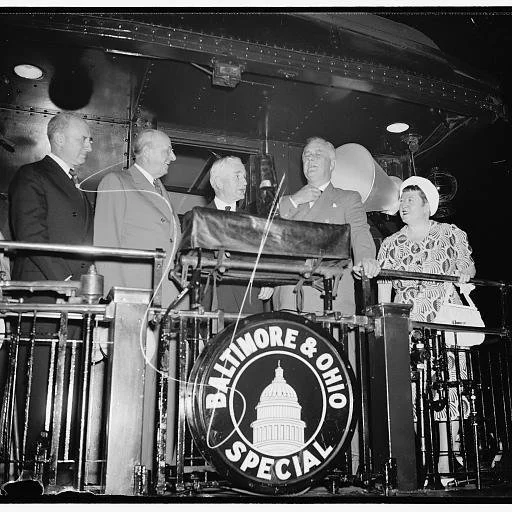
Image: President Roosevelt departs Washington on a voyage that includes urging support of New Deal candidates in upcoming elections. July 7 1938. Source: Library of Congress

29 June 2023 - Condominium, Complexity, and the Corporation. Douglas Harris (Recording Available)
Speaker: Douglas Harris (UBC)
29 June 2023, 10:00 am, LPGCIL Research Meeting
Melbourne Law School, Room 1002 (access via Level 9 stairs)

Image credit: Wikimedia
The condominium form combines elements from land law and corporate law to produce individual parcels of land coupled with undivided shares of common property and set within a structure of local government. A massively successful innovation when measured by its proliferation, condominium now dominates residential new-build construction in cities around the world. As the number, scale, and complexity of condominium governments increase, is their particular corporate structure fit for purpose?