22 October 2026 - Sharing the Benefits, ‘Community Participation, Consent and Democratic Governance’ (in Spanish)
Thursday 22 October 2026, 9am AEDT | Wednesday 21 October, 7pm CST
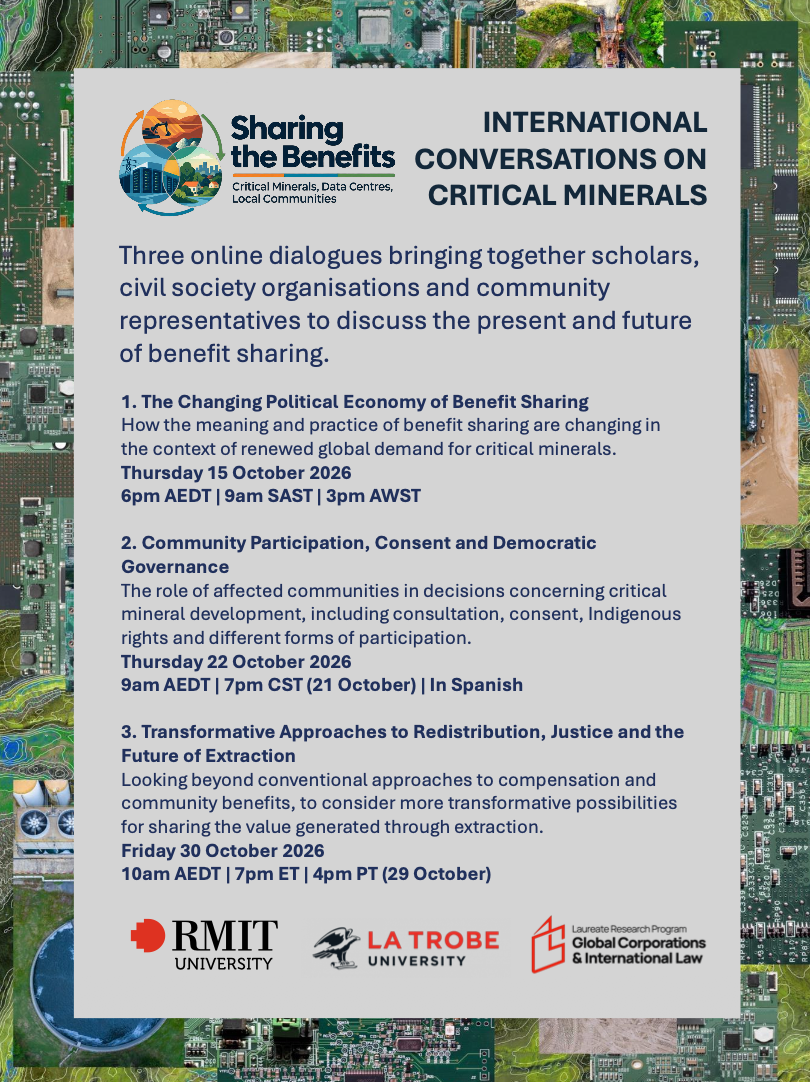
The second dialogue will focus on the role of affected communities in decisions concerning critical mineral development.
It will examine consultation, consent, Indigenous rights and different forms of community participation, while asking how far existing governance arrangements allow communities to influence not simply the distribution of benefits but the terms on which extraction occurs. Particular attention will be given to the institutional and political conditions required for meaningful participation and to experiences in which communities and civil society organisations have sought greater control over extractive decision-making. The discussion will include Nicolás Perrone (Universidad de Valparaíso), Alexis Romero (community leader, Solor), and Roger Merino (Universidad del Pacífico).
This conversation forms part of the larger project Sharing the Benefits: Critical Minerals, Data Centres, Local Communities that brings together researchers, public officials, civil society organisations and communities to explore how the benefits and burdens of the green and digital transitions can be shared more fairly. Through an online international dialogue series and an in-person local government workshop in Melbourne, the project creates a space to compare experiences, identify emerging practices and build a longer-term research and policy network. Sharing the Benefits is a collaboration between Luis Eslava (La Trobe University), Caitlin Murphy (RMIT) and André Dao (University of Melbourne), and is supported by the Laureate Program on Global Corporations and International Law at the Melbourne Law School and BHRIGHT at RMIT.
Registration form available soon.
Image- Silicone Landscapes, Sinem Görücü, https://betterimagesofai.org / https://creativecommons.org/licenses/by/4.0/