‘Bad states, good corporations? The intersecting histories of business and human rights and international investment law’
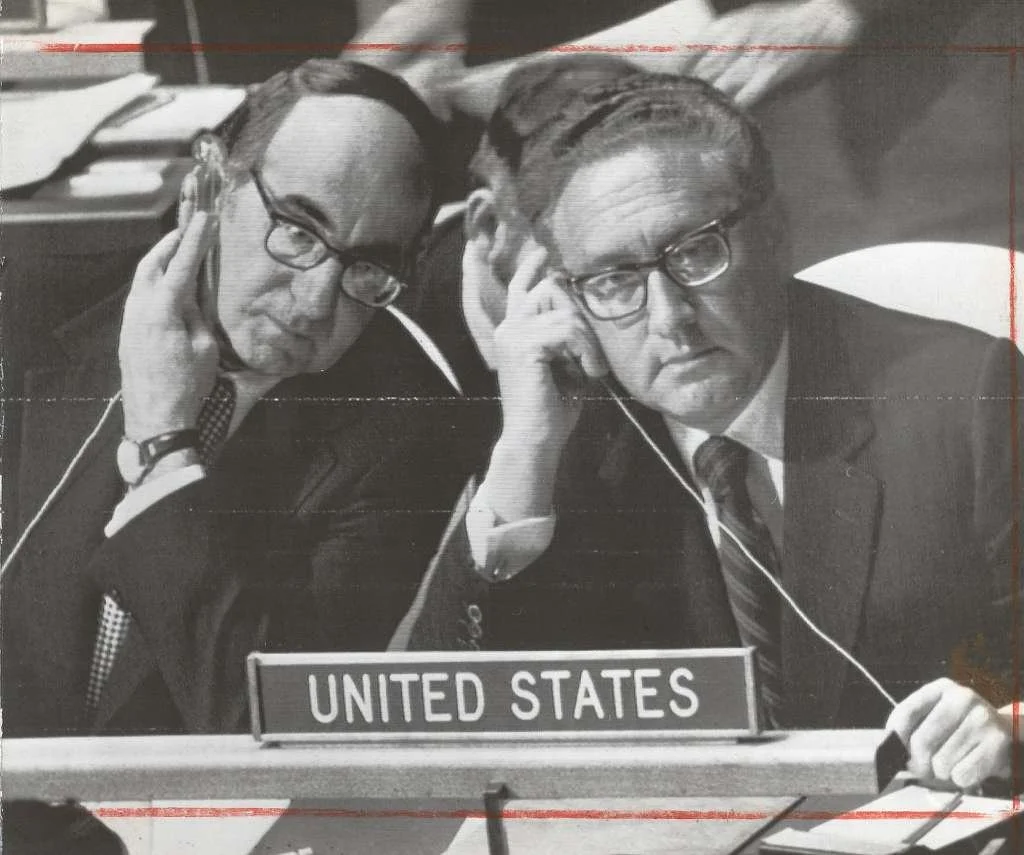
Henry Kissinger at the UN in 1974. Source: Arquivo Nacional.
By André Dao, Caitlin Murphy and Sundhya Pahuja
In the earlier volume of this series, we described the attempt in the 1970s by the ‘Group of 77’ developing states to establish the UN Commission on Transnational Corporations. The G77 initiative sought to internationalise legal control over the conduct of multi-national corporations, whilst at the same time, to (re)assert national sovereignty over the ownership of property. The objective was to minimize the negative effects of corporate activity whilst harnessing the benefits for the societies in which MNC’s operated, as well as to address historically unjust patterns of foreign ownership, whether formally colonial or not. This chapter continues that story and describes what happened next. In essence, countries in the ‘First World’ were hostile to both these objectives. But rather than just blocking the initiative, through the active efforts of a new coalition of rich countries, the two objectives were disaggregated and reversed. So rather than a situation of international authority being asserted over corporate conduct, and national authority inhering over corporate property, what the first world asserted – and what eventually came about – was internationalized protection for foreign property through ‘international investment law’, and national responsibility for corporate conduct through ‘business and human rights’. When we attend to the story in this way, we can see how in the battle over corporations in the period from 1975 to 2000, elements of the world were remade (again) such that the suffering of the poorest was called upon to authorise the protection of the property of the richest. This continues to be patterned by international lawyers into international law.
PDF available here.
Citation
Dao, André, Murphy, Caitlin and Pahuja, Sundhya, ‘Bad states, good corporations? The intersecting histories of business and human rights and international investment law’ in Jochen von Bernstoff, Phillip Dann and Surabhi Ranganathan (eds), The Battle for International Law II, 1975-2000 (Oxford University Press, forthcoming).